


Exploring the Divine Love in the Bride of Christ Part 5 of 6

Exploring the Divine Love in the Bride of Christ by Guest Blogger Alex Smith.

Canticle 4:12 - 16 “A garden enclosed is my sister, my spouse; a spring shut up, a fountain sealed. Thy plants are an orchard... with all the chief spices: a fountain of gardens, a well of living waters, and streams from Lebanon.”
Thus Solomon describes with many metaphors his love.
The Shulamite responds, “Awake, O North Wind, and come, thou South— blow upon my garden, that the spices thereof may flow out. . . Let my beloved come into his garden, and eat his
pleasant fruits.
Notice again the imagery of “hidden-ness”, or “private-ness”. An “enclosed” garden— with a high stone wall around it. Only those privileged to gain access may enter. It’s private: not for everyone. The phrase “my sister, my spouse” refers to Christ as our elder brother, and we as his “sister” and “spouse” … “the first-born among MANY BRETHREN.” (Romans 8:29). WE are the “many brethren”, which includes sisters. The Hebrews saw their fellow-countrymen as brothers. So Solomon speaks of Abishag as his “sister”, so also we are Christ’s “brothers”. See also Deuteronomy 18:15 and 18 (“A prophet will I raise up of your brethren.”) “A spring shut up, a fountain sealed.” Like a well-spring with a lid over it, to keep out dirt, bugs, birds, etc. It’s ONLY for the privileged few to drink from, in this case, the One.
Proverb 5:15 - 21 uses similar imagery applying to husbands and wives, “Drink water from thine own cistern, and living water from thine own well...” This well, or spring, is not a stagnant pool of standing water: it is living water— that is running freely. In the last day of the great Feast, just as the priest was pouring out the water and the wine onto the Altar of Sacrifice, Jesus stood up in the courtyard of the Temple and cried out, “If any man thirst, let him come unto ME and drink: and out of his belly [his inner-most being] shall flow rivers of living water!” (This spake he of the Spirit, which they were later to receive.)” —John 7:37 - 39a.
Jesus wants us to “drink” of him.
He also wants to “drink” from us— IF we have that much love for him; like the Shulamite, it would be a “refreshing, life-giving drink” for him, of our adoration and praise.
The Shulamite responds in an interesting fashion: she calls for the North wind as well as the South to blow: to cause the spices, and their fragrance, and the fruits to “flow out”. Why the NORTH wind? Because it’s the cold north wind of TRIALS that perfect us, James says. “Count it all joy, brethren, when you are tried and tested: knowing this, that the trying of your faith brings forth patience. And let patience produce her perfect work, that ye might become mature and complete, lacking nothing.” (James 1:2 - 4)
Why the SOUTH wind? It’s the warm wind from the heat of the desert that ripens the fruit. We need trials! But we also need blessings. Paul said, “Whether I abase or abound... I can do all [as in, “both”] things in Christ who strengthens me.” (Philippians 4:12 - 13) The result is that WHEN FULLY RIPE, the Bride says “Let him eat his pleasant fruits.” The Lord will allow things in our lives that will “ripen” us— IF we co-operate with him! THEN he can truly enjoy the fruit of our spirits and hearts. He won’t want to eat unripened immature fruit— that is not ready.
That’s what a good deal of this is about— maturing in love before him. Developing love to a point of maturity. Deeper love; deeper commitment.
Cant. 5:2 - 6 “I sleep, but my heart waketh: it is the voice of my Beloved that knocketh, saying, ‘Open to me, my sister, my love, my dove, my undefiled: for my head is filled with dew, and my locks [of my hair] with the drops of the night.’ “
Look at the sweet terms of endearment with which the King is calling his love! And he even says that his hair is all damp from the night dew— appealing to her that he needs ministering to himself. Most women do have a motherly instinct, even for their own husbands as well as for their children. But no...
She replies sleepily, whining, complaining: “I have put off my coat; how shall I put it on [again]? I have washed my feet [for the evening, before getting into bed]; how shall I defile them [again]?” —Solomon then reached through the lattice-work of this eastern summer apartment, and reached around to the inner door-latch, which was a sort of complex combination lock sequence of lever positions, and undoes it for her... but does not enter. He “unlocks” the door, but he does it in order to make it easier for HER, not for himself. He waits outside.
Abishag continues her soliloquy, describing this: “My beloved put his hand in the hole by the door, and my bowels [the depths of her being/ her heart] were moved for him.” —She had the emotional response within her... BUT not enough to motivate her to ACTION, just then.
Disappointed with her lack of response, he LEAVES.
“I rose up to open to my Beloved; and my hands dropped with myrrh, and my fingers with sweet-smelling myrrh, upon the handles of the lock. —I opened to my Beloved; but my beloved had WITHDRAWN HIMSELF and was GONE! —my soul failed when he spoke... I sought him— but I could not find him! I called him— but he gave me no answer.”
How much is this like the Church of Laodicea— lukewarm, somewhat “hot” but not really enough... enough to say “yes”, but not enough to DO it. To his own CHURCH— His own Called-Out Ones— Jesus calls, “Behold, I stand at the door and knock! If any man hear my voice, and open the door, I will come in and sup with him and he with me!” (Revelation 3:20) Eating dinner together was seen as an intimate time of fellowship, and a great honour. Jesus is promising a TWO-WAY relationship “and he with me”.
When Jesus told Zacchaeus, the short-of-stature tax collector that he would eat at his house that day, he wasn’t imposing himself: he was giving Zacchaeus a great honour!
Why does it say “myrrh” on her hands? Because myrrh was a costly spice, normally used for embalming the dead— thus symbolising “Death to Self” in her works, her “hands”— that by which we do our works. But she was. . . …-Late- !
I cannot emphasise the warning enough: Please respond, NOW, when the Lord calls you to arise!
Cant. 6:8 - 9 THIS IS A KEY PASSAGE. Solomon boasts about the Shulamite’s unique characteristic: that although he has many women, some with whom he has occasional intimacy— SHE is “the Choice One”.
“There are three-score (60) queens, and four-score (80) concubines, and virgins without number: my Dove, my Undefiled is but ONE: she is the only one of her mother; she is ‘the Choice One’ of her that bare her.”
See the diminishing numbers correlating to the depth, or level, of Relationship. They ALL had a relationship with the King: they were ALL part of his Court.
“Virgins without number”. (Not literally, but MANY). These were Court girls, that SERVED in the Royal Court.
Lesser in number, but inversely, deeper in the level of relationship, are the Concubines. These were legal wives, but they were “secondary”, as their children could not inherit. In a king’s court, he would have intimate relations (in bed) with a concubine, arbitrarily, now and then. But they did have “occasional” intimacy.
Fewer even in number than the Concubines, there are the Queens— wives made through political alliances with other kings. Here in this verse, Solomon has sixty... later he amassed 700. (See I Kings 11:3)
But least in number, but CLOSEST TO HIS HEART (“but one”)... is the Shulamite. And he calls her his “dove”, and his “undefiled”. But especially, of all the children born to her mother, he calls her “the Choice One.”
—This is a pretty strong typological picture of Christians! There are millions who know the Lord... they are saved, and they are truly “servants of the Lord”. But that’s about as far as it goes, with them.
And there are those, fewer— who DO have occasional times of intimacy with his heart.
Would that we all would continually seek to be close to the heart of Jesus! And fewer yet are those who are like “queens”... they possess some measure of authority and rulership. Although the promise of Authority is given to all who will believe and receive it (Luke 10:19 “Behold, I GIVE YOU AUTHORITY to tread upon serpents and scorpions, and over all the power of the Enemy: and nothing shall by any means hurt you.”) not all DO take their position in God and have faith in Him to EXERT that Authority which He has given! But there are some, like the “queens”, when they pray against demonic spirits— those spirits respond and FLEE. Or when they pray for healing, much more frequently their prayers seem to get answers. We all should have authority, in the Lord. But some DO have it!
And speaking in this manner, that “the Bride” is not just one person, it’s an entire group of people... but this description not only says “one”, indicating the singular position these people occupy in being that close to the heart of the Lord— he says “the Choice One” of her mother (representing the Church). Some might say “It’s not fair that some should be singled out to be ‘the Choice One’ “. Yeah, but who can tell? Only the Lord God of Heaven and Earth has the ability and perception to make a true judgement of who is in this position before Him, and who is in that position. WE can’t... and oughtn’t. But what we can do, is to “exhort one another daily, while it is yet called ‘Today’.” (Hebrews 3:13a). Press in to BE in that place of being his “Choice One” !
Cant. 6:13 The Women of the Court say “Return, return, O Shulamite, that we may look upon thee!”
And the Shulamite replies (in amazement at this) “What will ye see in the Shulamite?”
And they answer “As it were, the company of two armies.” (KJV) — the literal rendering is, “the dance of two companies/ groups” or “the dance of Mahanaim”.
The background of this is verse 12 in which she refers to being carried along on “the chariots of Aminadab”— literally, not a chariot with wheels, but rather a royal Palanquin, or litter (like a small fancy seat with tent-like cloth hangings over it, being carried on two poles, by several hefty servants). The word “Aminadab” might have been one of Solomon’s chief chariot drivers, swift and sure— but the MEANING of the word is: ‘Ammi’ - my people, ‘Nadib’ - princely, or noble, or WILLING. I see this as: the Bride is being borne on a palanquin by willing people. In our application to “people with the Heart of The Bride”... we can’t make it on our own. We are dependent on the Lord IN His people... we are all part of the Body of Christ, and we do NEED each other. They help “carry us along” at times.
The Women of the Court (also known as the Daughters of Jerusalem) have played their part in bearing along the Shulamite, but ask her to return “that we may look upon thee”. In comparison with the glory of the King, she modestly asks “Why? What do you see in me?” Our focus is glorifying Jesus, not ourselves. “Not unto us, O Lord, not unto us: but unto Thy Name give glory!” (Psalm 115:1)
They respond in a cryptic fashion: “As it were, the dance of two companies” or “the dance of Mahanaim.”
Now, in Genesis 32:1 -2 Jacob sees the angels of God, and names the place “Mahanaim” that is “two companies” (of angels).
When I first looked at this verse, I thought, “The heavenly dance of praise, made up of two groups— saved Jews and saved Gentiles”. But I wonder— could it mean “What do we see in The Bride? The beauty and grace of the dancing of two groups of God’s angels— a heavenly dance, spiritual in nature, borne forth by God’s holy angels, but acted out in worship to Him in a heavenly dance!” -Psalm 149:3 “Let them praise His name in the dance” and Psalm 150:4 “Praise Him with the timbrel and the dance.” When the Ark of the Covenant (carrying and embodying the Presence of YHWH) was being brought into Jerusalem, King David “danced before the Lord with all his might”. (II Samuel 6:14)
Although the Shulamite does not see herself as that special, the Daughters of Jerusalem see in her the gracefulness of this heavenly dance of praise and worship— a dance of the angels, superlative in nature. Wow.
I would hope and pray that the spirit of pure worship to God just pours out of us, and is that evident in us.
Cant. 7:2 “Thy navel is like a round goblet, which lacketh not liquor: thy belly is like a heap of wheat set about with lilies.”
This is but one of many descriptive passages that many tend to think to be “erotic”. But there is rich symbolism in these similes: it is up to us to dig, like a miner, to find the buried gemstones of meaning. In Canticle 4:1 - 5 the King enumerates the Shulamite’s beauty, using similes for her Eyes, Hair, Teeth, Lips, Temples, Neck, and Breasts.
Biblical scholar James Neil, in his book Palestine Explored, 1882, wrote: “The Easterns still, as in ancient times, use the greatest plainness of speech throughout the Holy Land. At first, a Western sense of delicacy is greatly shocked. Things, the very mention of which decency forbids amongst us, are there freely spoken of before women and children by people of the highest class, and of the greatest respectability and refinement. . .”
So I shall use this one verse as an example.
What is one’s navel? It is the “plugged-in source” of nourishment for a baby within the womb, where the umbilical cord attaches. It’s the very centre of the belly.... where GOD, like a “mother” feeds us with spiritual milk. But here, the Bride is not seen as a pre-born baby, but as an adult, whose inner-most being (the “navel”) contains liquor, not milk. Strong liquor is not forbidden in Scripture: indeed, the Tithe commanded by the LORD was to be set aside unto Him, but then eaten by those giving it! (Deuteronomy 14:26) And “if it is too far to bring it” (actual food-stuffs), “then you are to turn it into money; and with it buy whatsoever your soul desires: oxen, sheep, wine, or strong drink” —and eat it yourselves! We as new-born Christians, have needed milk (Hebrews 5:12 - 13 i.e. simple doctrine) FROM the Lord; but here, the Shulamite is portrayed as giving TO the King, from the very centre of her being, not milk, but the libation of maturity that intoxicates him with great delight! Plus, it is not wine, which is fermented; but liquor, which is distilled, indicating Purity.
Still focussing on this “inner-most core of her being”, he says that her BELLY is like “a heap of wheat”. There were two grain harvests in the spring of the Land: first the wheat, then the barley. Wheat is a much more nutritious and therefore valuable grain; you can see this in Revelation 6:6 where one will be able to buy three times the amount of barley for the same price as one measure of wheat (because barley isn’t nearly as nutritious). There IS a qualitative difference in the lives of Christians: we are rewarded according to our works (but not SAVED by our works). Seek to be a “wheat” Christian— don’t be satisfied with just being a “barley” Christian. But when is wheat in a HEAP? Only when it is harvested, taken to the threshing floor, and the chaff is beaten off with the flail, and the winnowing fan blows it away. THEN the precious grains of life-giving wheat are heaped up. But in this Canticle, Solomon is proclaiming that her belly has the characteristic of “a heap of wheat”.
Jesus said in John 7:37 - 39 that “out of your BELLY [that is, out of your inner-most being] will flow ‘rivers of living water’ ” when we receive and are filled with the Holy Spirit.
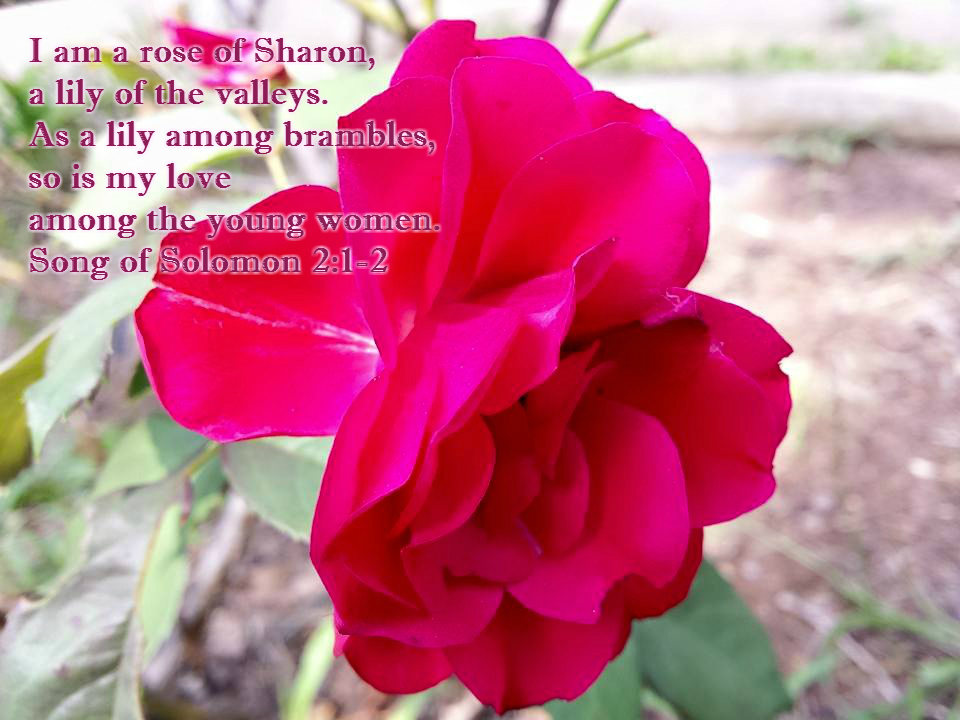
Here in this typological picture, is not just “living water” coming OUT, to nourish and refresh others... this description speaks of the END RESULT: a bountiful harvest of mature souls for the Lord— ones that possess a depth to be counted as the more nutritious “wheat”, rather than the less nutritious “barley”. But the end of the statement says “set about with lilies.” That could also be put, “surrounded by lilies”. As shown earlier, the lily is actually a type of crocus that gives forth a sweet smell, and whose stamens are made into a very expensive spice (saffron), but at the same time, is a common flower growing in a wide plain, or valley (amidst the common strains of humanity), and yet “hid in the clefts of the rock”— hidden away, not noticed, protected and secretly nurtured.
This picture of the Heart of the Bride shows us that out of our inner-most being will flow “liquor” unto the Lord’s delight— and unto people, “living water”, and the result will be a harvest of souls for the Lord; but better than that, it will be a harvest of mature (“wheat”) saints, gathered in (the “heap”), tested and tried by the threshing process... and yet, in the sweet fragrance, simplicity, and hidden beauty of the “lily” in amongst the masses of common people.
Next time Part 6/6.


Comments